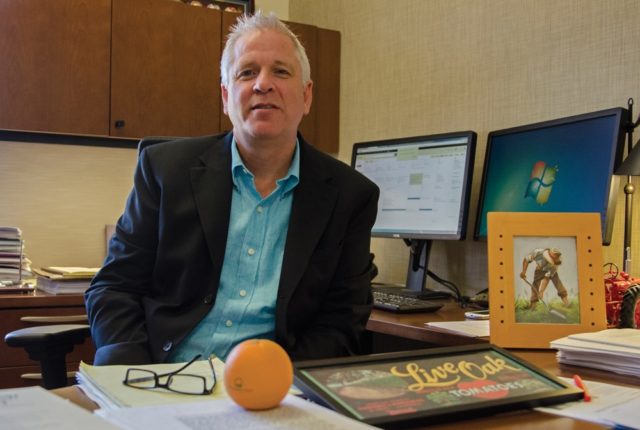
A red vintage model of a tractor sits next to a foam orange fruit and an old-fashioned sign for tomatoes on the bookshelves in Michael Roberts’ office in the UCLA School of Law.
“I think food has a really personal meaning for all of us,” said Roberts, sitting behind his desk, his food-themed paraphernalia spread out in front of him.
Roberts is the executive director of the Resnick Program for Food Law and Policy at the UCLA School of Law. The program, which started this year, is the first of its kind at the UCLA law school.
Roberts said he tries to integrate food into his classes as much as he can. Currently, he is teaching about olive oil and how it is processed.
As part of the class, he has his students taste three kinds of olive oil – high grade, medium grade and low grade – to show them there are differences in the quality of food.
There is an undeniable connection between food and health, Roberts said, and he intends to teach his students how the law can create a better food system – and therefore a better quality of life.
“I think the (Resnick) Program is an incredible opportunity for us to take a leadership role in food law and policy,” Roberts said.
Roberts’ father was a produce broker and, while Roberts grew up, their family moved around, from Orange County to Seattle to northern Utah, to follow his father’s produce operations throughout the West.
“I am comfortable with food policy because I grew up around food,” Roberts said.
Roberts worked every summer on his grandparents’ farm, and he told himself he would never go into the agriculture business.
The labor on the farm was grueling, which made Roberts initially shy away from a physically demanding occupation, he said. Rather, he preferred to pursue an intellectually demanding career, which is why he chose to attend law school.<>” class=”inline-comment collapsed”>
But 13 years ago, Roberts decided to leave his job as a lawyer in Utah. He said he wasn’t happy in his career, and he was initially intrigued in food policy when he read a Harvard Business Review article about the emerging law topic.
He searched online and found the LL.M. Program in Agricultural & Food Law at the University of Arkansas, the only such program in the country at the time.
The program was intended to give individuals who had already completed law school a way to develop a specialization in food law, said Susan Schneider, Roberts’ good friend, colleague and law professor and director of the LL.M. Program in Agricultural & Food Law at the University of Arkansas School of Law.
Schneider said she was so impressed with Roberts after one conversation on the phone with himthat she accepted him into the program.
At the time, food law was not as developed as it is today – Roberts was moving into mostly uncharted territory.
“He was willing to leave his successful law firm to study agricultural and food law before it was cool to do so,” Schneider said. “I give (Roberts) credit for being a pioneer in that respect.”
Roberts is interested in new and innovative ways to approach the law, Schneider said.
Neil Hamilton, Roberts’ good friend, colleague and director of the Agricultural Law Center at Drake Law School, said Roberts is one of the most valuable colleagues he has ever known.
“He’s the one I look to for advice. He creates opportunities for me,” Hamilton said.
Roberts is anxious to learn about food law and policy so he can better teach about it, Schneider said.
“He is excellent in working with students because he is good at bringing a fresh perspective,” she added.
Roberts said he has been overwhelmed with the students’ interest and excitement about the Resnick Program. Currently, his class has 20 students, surpassing the class limit of 16.
The waiting lists for his classes have filled up, and his students have formed a group called the Student Food Law Association.
“I always tell my students, ‘You won’t all be food lawyers, but you’ll all be eaters for the rest of your lives,'” Roberts said with a laugh.
