This post was updated Jan. 29 at 9:52 p.m.
Editor’s note: This article, its photo caption and its headline were updated Jan. 25 at 7:58 p.m. to remove the description of the Sepulveda Transit Corridor project as a “high-speed rail” line. In fact, the rail line that has been approved to run with a stop on the UCLA campus is a heavy rail line that LA Metro has described as “fast transit.”
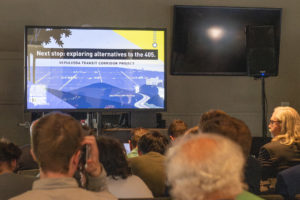
The Los Angeles County Metropolitan Transportation Authority unanimously approved a multibillion dollar heavy rail plan through the Sepulveda Pass – which includes a stop on UCLA’s campus – Thursday.
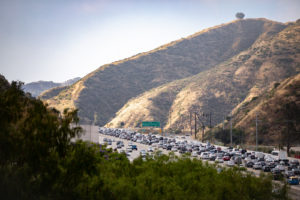
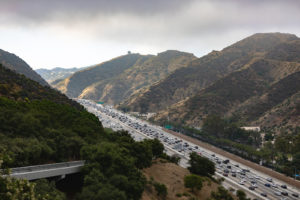
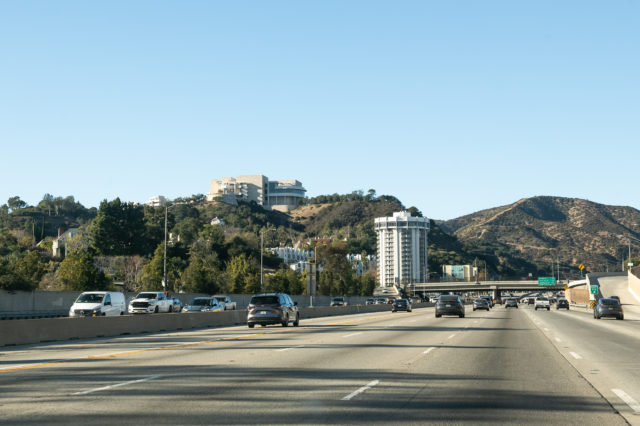
The Sepulveda Transit Corridor project – which has a target completion date of 2033 – would link the Westside and the San Fernando Valley through a tunnel in the Santa Monica Mountains, aiming to alleviate congestion on the 405 Freeway and lower travel time to under 20 minutes. More than 400,000 people cross the Sepulveda Pass daily during the work week, and the average commuter loses 59 hours annually because of traffic delays on the 405 between Wilshire Boulevard and Ventura Boulevard, according to a May press release from LA Metro.
The LA Metro Board of Directors approved a modified version of alternative five, one of the plan’s five potential train and route options, which would include an on-campus stop at UCLA Gateway Plaza and direct connections to other Metro lines, such as the Metro E, D and G lines.
“A direct rail connection through the Sepulveda Pass will connect people to jobs, schools, airports and entertainment faster than ever,” said Metro Board Chair and Whittier City Councilmember Fernando Dutra in a Thursday press release. “This project will cut travel time, reduce air pollution and is the kind of bold, forward-looking investment that moves Los Angeles County into the future.”
LA Metro staff recommended a modified version of alternative five to the board’s planning and programming committee Jan. 9. The committee pushed the proposal forward last week and designated it as the Locally Preferred Alternative.
[Related: LA Metro staff recommend transit project alternative including UCLA stop]
Two members of the Undergraduate Students Association Council’s Facilities Commission gave public comment at the Thursday Metro meeting in support of the STC project and its UCLA stop.
Winston Li, FAC’s co-director of transportation equity and access, said the commission was excited by the board’s decision and encouraged by the number of people who spoke in favor of the project’s approval at the meeting. He added that some people planning to participate in public comment were unable to because of the volume of attendees.
“It’s going to increase connectivity,” said Li, a fourth-year political science and statistics and data science student. “It’s going to increase opportunities for people to potentially get more affordable housing options and not have to stay within the Westwood area. … It … delivers on what we want, which is an equitable and accessible transportation solution.”
Li added that the project will make it easier for students to work off-campus jobs and internships, as well as to commute to campus.
“There’s more and more commuter students every year, and a lot of them travel from over the Pass to UCLA,” he said. “I actually met one student who currently takes the commuter express bus. And one of the biggest issues with that is, first, it gets stuck, and second, it only operates during certain times of the day, and if the Sepulveda line had existed for him, he would have been able to get to UCLA at any time of the day, in less than 20 minutes.”
Li said the commission has advocated for a UCLA campus stop for months by encouraging students to email and call the Metro board, providing templates for public comment at meetings, sharing information on social media and holding a press conference so students can better understand the project.
He added that UCLA Transportation and UCLA Government and Community Relations chartered a free bus to the Thursday Metro board meeting so more students could voice their support.
A UCLA spokesperson called Metro’s approval a milestone in an emailed statement. They added that the school plans to formally endorse the project after Metro addresses operational concerns – including construction disrupting campus operations and UCLA buses – identified in UCLA’s Draft Environmental Report comment letter submitted last year.
“UCLA will continue to work collaboratively with Metro to address key construction and operational concerns identified in UCLA’s Draft Environmental Impact Report comment letter submitted last year, with a focus on minimizing disruption to core campus functions,” the spokesperson said in the written statement. “Expanding public transportation options is critical to supporting access to campus and sustaining UCLA’s academic, research, healthcare, and public service missions.”
USAC President Diego Bollo, who also attended the meeting, said in a texted statement that the council is proud of its advocacy for an on-campus station.
“By connecting the Valley to the Westwside, we can make higher education more accessible and build a stronger relationship with our Angelino neighbors,” he said in the statement. “Commuter students must have public transit available to them to get to classes, work, and participate in our world class research. UCLA’s on campus station is expected to have the highest usage rate out of the entire Metro system– proof of UCLA’s socioeconomic importance to the region.”
The project, which was first proposed in 2016, was initially estimated to cost $6 billion but is now projected to cost $24.2 billion. Board members said this figure does not reflect cost-cutting changes such as fewer stops and “more direct alignment.”
LA Metro has said little about how it will secure the project’s funding, with only about $3.5 billion currently secured from Measures R and M, which raised LA’s sales tax to fund transportation projects – approved by LA voters in 2008 and 2016, respectively.
Li said though the project passed, the fight for an on-campus UCLA station is not over. Metro is set to release its Final Environmental Impact Review in one to two years, which would mean the board would revote on alternative five, he added.
“There will be another round of voting, and even though we didn’t get that much pushback this time, it’s possible that, for example, certain residents in Bel-Air will try to push back next time or try to file lawsuits against it,” he said.
Fred Rosen, a board member of the Bel-Air Association – which previously opposed alternative five – said the board is strongly against Metro’s plans to tunnel beneath Bel-Air and believes that the project is a “delusional dream.” He added that he does not believe the project will come to fruition for decades, if at all.
“The tunnel-digging incompetent morons of Metro want a 19th century solution for a 21st century problem,” Rosen said.
Rosen added that citizens of Bel-Air could take legal action if the plan moves forward.
However, Li said FAC will continue to support the initiative in any way it can.
“We owe it to future UCLA students to leave them with the best transit network, our best access to transportation that they can have,” he said.