This post was updated Feb. 5 at 10:12 p.m.
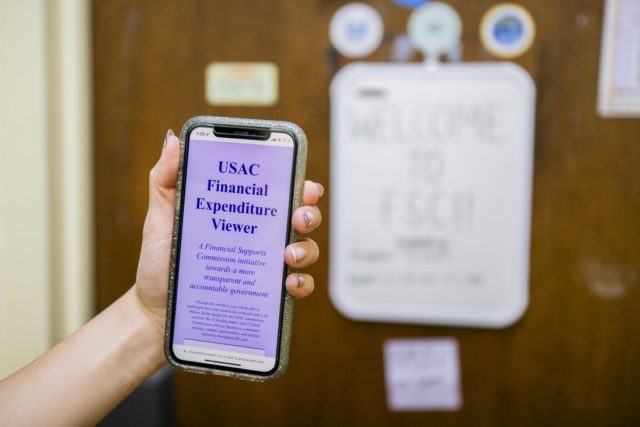
The Undergraduate Students Association Council’s Financial Supports Commission anticipated releasing a finalized financial transparency website detailing the council’s funding allocations by June 2025.
Months after the original deadline, the website still showed data from USAC’s 2024-25 academic year budget. It also did not provide commission-specific financial data – which the Financial Supports Commission said it would include – as of Feb. 3.
Financial Supports Commissioner Nico Morrone, who first pitched the website last winter quarter, said the proposed website is meant to provide students with information about their quarterly USAC fees, programming fund budgets – which student organizations can apply for – and how USAC commissions use their budgets.
UCLA students pay a quarterly USAC fee of $104.31, which contributes to the council’s total budget of $10.9 million for the 2025-26 fiscal year.
Each USAC officer is paid $17.87 per hour and can claim up to 20 hours per week during the academic year, as well as seven weekly hours during the summer. The maximum amount a USAC officer can earn annually is $15,332.46.
[Related: USAC increases stipends, cuts pay for USA Judicial Board for 2025-26 fiscal year]
A page on the current website said it is in “Phase 1 and is still a Work In Progress.” A message posted to the website from the Financial Supports Commission said the office is dedicated to providing full transparency with regard to USAC’s budget and will ensure the council uses all student fee-generated funds to improve the UCLA college experience.
The message also said the funding pages are complete but have not yet been updated for the current year.
Morrone said in a March 4 emailed statement that the website would be published in spring 2025, as its developers worked through bugs. He said in an April 1 emailed statement his team was still ironing out details but the site would be launched in the following weeks.
He said in an Oct. 12 statement that his team did not work much on the website over the summer, but it would continue building the project throughout fall quarter. Morrone did not mention the website in any of his written officer reports during the summer.
Morrone said the site would have different pages, which would give students information about each of USAC’s funding bodies and display the council’s allocations and remaining programming budget. This, he said, would help student organizations as they applied for programming funds.
“Over time, we’ll calculate it so it clearly displays how much money is left in each funding body and if that funding body has any money left to be even accepting applications,” Morrone said. “That way, hopefully, if student orgs did apply to the funding body and they get immediately rejected, then they can go in and check and they can see it was probably because the funding body doesn’t have any money left in it. Or, if they didn’t get full funding for something, they can go in and see how much money that funding body has to see if there was even a budget to be able to give full funding.”
Morrone said in a Dec. 3 statement his team would work through the website’s coding issues during winter break, and added that he planned to start collecting the financial data during the first week of winter quarter. He said he also planned to finalize the website’s pages detailing USAC funding bodies at the start of winter quarter.
Morrone hopes to work with USAC commissioners to have the council’s finances uploaded by the end of winter quarter, he said in the December statement.
“The goal of this Viewer is to make the USAC budget more comprehensive and transparent for all students,” Morrone said in an emailed statement. “We’ve made some great progress thus far, but there’s still so much work to do to ensure USAC is fully financially transparent with the student body.”
The Sikh Student Association applied for USAC’s Community Service Mini Fund but experienced delays in receiving the funding, a group representative alleged at USAC’s Jan. 6 meeting. The club was told its request was under review, the representative added.
“If you ask questions, they’ll (USAC’s financial advisors) explain it to you to the best of their ability, but you have to go looking for the information,” said Sikh Student Association’s Finance Director Sarah Johal. “I don’t think it’s readily available – you have to ask, and if you do, you will be able to get their information, but it is definitely harder.”
USAC’s near $11 million budget raised stipends for its officers but lowered those of the USA Judicial Board.
USAC’s budget report – which includes each commission’s expenditures and allocations – is about 400 pages but goes into little detail about what each allotment is. It labels spending with general terms, such as commission and department-related services, subscriptions or programming.
Some commissions manage six figures in funds, according to the budget.
“Over the summer, I was attending public comments, and I was particularly asking about the budget, ‘Why can’t I know the budget?’” said Eli Sepulveda, the chief justice of the USA Judicial Board. “For starters, because it’s all of our tuition, it’s also public funds – but also because, as a part of USAC, it makes sense that internal bodies should be aware of what the budget is.”
Sepulveda said the 2024-25 council made the budget available almost immediately after it was passed. The 2025-26 budget was finalized over the summer but was not posted until October. President Diego Bollo said logistical, personnel-based errors and a person resigning caused recent budget delays.
Sepulveda also said he believed USAC has communication issues, which contribute to its transparency problems. USAC cut the USA Judicial Board’s stipends because USAC bases pay on the number of hours worked, Sepulveda said. He added that the council never asked how much the board worked and guessed instead.
Sepulveda added that this decision was particularly frustrating, since the board believed its pay would be calculated based on the previous year, when the board worked on four cases. The USA Judicial Board had not heard a case from 2021-24.
Transparency, Sepulveda said, would help students better understand how and why USAC makes certain financial choices.
Johal, a second-year computer science student, said the Sikh Student Association was able to secure its funding, but it took much longer than usual.
She added that the delay impacted a care package assembly event the club attempted to organize this quarter. USAC took too long to approve the club’s funding requisition application, Johal said, so it could not get all the needed supplies in time.
Clear communication, Sepulveda said, is essential for both understanding the budget and maintaining trust between USAC and the student body.
“People’s understanding is that they know how much it (the budget) is. They don’t necessarily know that not all of it is used, intended for specific programming or for specific funding bodies,” Bollo said. “That’s what I think people have a misunderstanding of and with FSC. I’m hoping to work on creating a smaller report of how much of the money is used for grants and how much is available to students.”
USAC officers, Sepulveda said, have a responsibility to clearly communicate how and why they make budgetary decisions to the people that fund their efforts – the students.
“At the end of the day, this is student money that funds USAC, and it is a privilege to be able to be in USAC – especially to be in a stipended, elected officer position,” Sepulveda said. “When students are funding certain elected officials to do their job and do that role – and when they campaigned on transparency – it seems hypocritical not to have fiscal transparency with students.”



Comments are closed.