For a moment, it almost seemed refreshing.
Stephen Agostini, UCLA’s then vice chancellor and chief financial officer, admitted mismanagement was a factor behind the university’s $425 million alleged annual deficit, in an interview with the Daily Bruin published Feb. 13. It was a rare example of a campus administrator giving a candid interview.
“I spent a long time in the federal government,” Agostini told The Bruin. “I have rarely seen the kind of financial management flaws and failures that I see here when I got here.”
Less than five days after the piece was published, Chancellor Julio Frenk announced in a campuswide email that Agostini had been replaced.
Agostini was one of UCLA’s most senior administrators, with previous experience at the University of North Carolina at Chapel Hill and as CFO of the United States Consumer Financial Protection Bureau. His colleagues lauded his appointment to UCLA as a major step forward for the university in February 2024.
The university won’t confirm Agostini was fired for speaking out, but the timing certainly seems to suggest it.
[Related: UCLA CFO out days after alleging history of financial mismanagement]
Within minutes of Frenk sending the email announcing Agostini’s departure, UCLA Newsroom published a statement denying recent reports of a $425 million deficit. UCLA spokespeople also asked The Bruin to publish the statement in full as part of our coverage of Agostini leaving.
Both moves draw concerning connections between Agostini’s comments to the Daily Bruin and his departure.
It is also not the first time an administrator spoke to The Bruin and was gone shortly afterward.
John Thomas was appointed as UCPD’s chief in 2024 with outstanding qualifications and a promise to build trust with the community. After counter-protesters attacked students with fireworks during the Palestine solidarity encampment, he admitted in an interview with The Bruin that his department did not have enough officers on duty that night.
Weeks later, administrators removed him as head of the department.
[Related: Pro-Israel counter-protesters attempt to storm encampment, sparking violence]
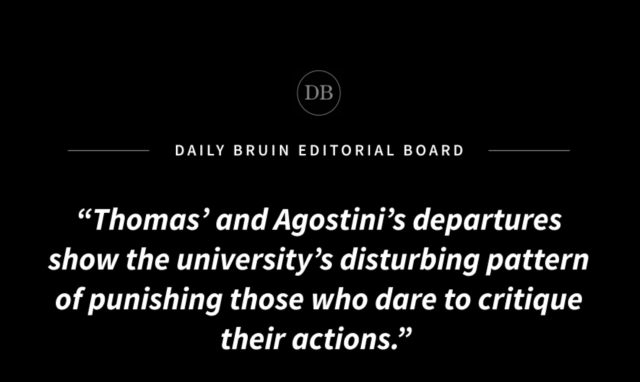
Thomas’ and Agostini’s departures show the university’s disturbing pattern of punishing those who dare to critique their actions.
In contrast, administrators who have made drastic mistakes – and refused to talk about them – are still in office.
Chief Information Officer Lucy Avetisyan was the executive sponsor for an IT project that wasted more than $200 million. Administrative Vice Chancellor Michael Beck oversaw a lackluster public safety response that put students in danger the night the encampment was attacked.
A UC report also found that an Incident Response Team meeting during the encampment was led by Mary Osako, UCLA’s vice chancellor for strategic communications. Her leadership meant police and administrators believed public safety decisions were being made with public relations, rather than appropriate expertise, in mind, the report said.
These actions speak volumes: Maintaining a pristine image is more important to UCLA than accountability or integrity.
Protecting this image should never take precedence over transparency.
A historic part of public accountability is providing open communication with the media. It is vital that administrators engage in candid conversations with us, free from fear of reprisal.
The truth is found not through carefully crafted statements and silence but through university administrators speaking directly to student media and the community. UCLA owes us – its students – the truth.
When institutions cover up mistakes by intimidating people who speak to the media, it usually indicates widespread leadership failures.
Systemic failures are evident in the numbers, but Agostini’s sudden departure threatens open communication.
What else does Frenk have to hide?


Comments are closed.