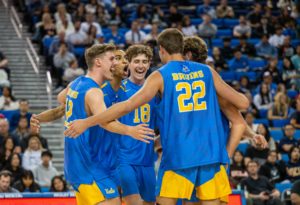
No. 1 UCLA men’s volleyball (14-0, 3-0 MPSF) will face crosstown rival No. 5 USC (8-1, 1-0) twice this week, first at the Galen Center on Tuesday and then at Pauley Pavilion on Friday. The rivals split their season series last year, with the Bruins taking the first contest in five sets at home before losing the second in a sweep. Daily Bruin senior staff writer Una O’Farrell analyzes USC’s strengths and weaknesses ahead of the crosstown showdown.
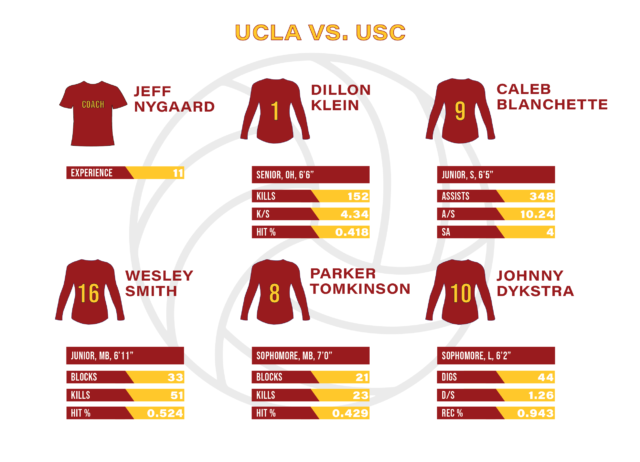
Coach: Jeff Nygaard
Best Player: Dillon Klein
Strength: Offensive efficiency
Weakness: Serve consistency
X-Factor: Caleb Blanchette
USC enters rivalry week with one of the MPSF’s more efficient attackers and multiple high-volume hitters capable of pressuring UCLA’s middle blockers. USC has leaned on a balanced pin production and steady distribution to remain competitive early in the season.
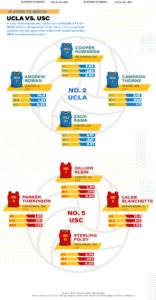
Outside hitter Dillon Klein anchors the offense. The AVCA First Team All-American selection has produced 152 kills across 35 sets while hitting .418 across this season, placing him among the conference’s most productive attackers. Klein’s combination of volume and efficiency make him the Trojans’ primary offensive option, particularly in out-of-system situations.
Supporting him is outside hitter Noah Roberts, who has recorded 71 kills across 27 sets on a .288 clip. While Roberts operates at a lower volume than Klein, his presence gives USC a second option that prevents defenses from overloading one pin.
By comparison, UCLA hit .405 as a team and averaged 13.73 kills per set, slightly outpacing USC’s offensive efficiency of .368 and 13.11 kills per set as a unit.
The middle provides additional efficiency. Wesley Smith has been especially effective, hitting .524 with 51 kills, while AVCA Second Team All-American Parker Tomkinson has posted a .429 hitting percentage in more limited action.
Distribution runs through setter Caleb Blanchette, who has compiled 348 assists – 10.24 per set – allowing the Trojans to spread touches across the net, and his ability to establish the middle dictates how freely Klein can operate on the outside. However, the Trojan’s offense may suffer from predictability if the Bruins can disrupt Blanchette’s usual rhythm.
Between efficient hitting and a productive offense, USC forces opponents to win extended rallies rather than rely on unforced errors, as evidenced by their sole loss of the year in a four-set duel with No. 4 UC Irvine.
However, service pressure and error management have been less consistent.
USC has committed 128 service errors, and its ace production – averaging 1.20 per set – has not always offset those miscues.
UCLA, meanwhile, has committed 164 attack errors compared to USC’s 127 but counteracts that with a higher kill tally and the country’s best team hitting percentage.
The Bruins may also need to account for USC’s size on the pins and in the middle. The 6-foot-11 Smith and 7-foot Tomkinson – the tallest player in program history – give the Trojans a physical presence at the net, while Klein’s high contact point allows him to score even against well-formed blocks.
With matches scheduled Tuesday at the Galen Center and Friday at Pauley Pavilion, the rivalry series may test whether USC’s offensive firepower can withstand UCLA’s serving pressure and transition game.


Comments are closed.