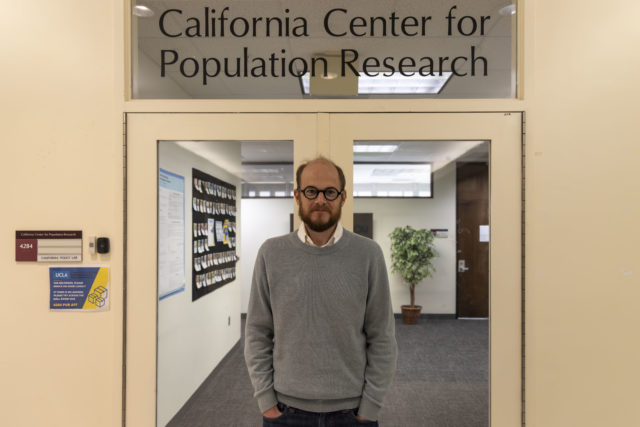
When Graeme Blair heard President Donald Trump’s promises to carry out a mass deportation campaign ahead of the 2024 presidential election, he began planning the Deportation Data Project.
The project – which Blair founded alongside David Hausman, a professor of law at UC Berkeley, and Amber Qureshi, an attorney who focuses on Freedom of Information Act litigation – posts datasets tracking the impact of federal immigration enforcement operations.
“We thought it was really important for Americans to understand what those changes were as they were happening,” said Blair, a professor of political science at UCLA. “We wanted to be able to obtain data in real time, to be able to look at who was being arrested, detained and deported, and to be able to share that.”
Deportations from the United States more than quadrupled during the first nine months of Trump’s second term, compared to the end of former President Joe Biden’s term, according to data from the project. The Trump administration has targeted Los Angeles as part of its mass deportation campaign, with federal agents conducting large-scale raids starting last summer.
During December 2025 and January 2026, ICE arrested an average of 1,264 people per day – an increase of more than 300% from the same months one year before, according to the American Immigration Council. The majority of those arrested had no criminal record.
[Related: ‘This shouldn’t be happening’: Students react to troops, ICE raids in LA]
The team looks at information that immigration courts post publicly on a monthly basis and regularly files requests under the FOIA – which allows people to request data from federal agencies – Blair said. While federal agencies are required to respond to FOIA requests within 20 days, Blair said this is rarely the case.
The Deportation Data Project has sued United States Immigrations and Customs Enforcement at least four times after FOIA requests went unanswered, but it still can take months to receive the requested data, Blair said. ICE did not immediately respond to a request for comment on the lawsuits.
The Deportation Data Project’s data has been cited in several lawsuits against ICE, including one where the American Civil Liberties Union, alongside several other civil rights organizations, represented plaintiffs who challenged immigration stops based on race in LA. While a lower court temporarily paused such stops, the Supreme Court issued an order in the case in September that allowed ICE to stop people based on factors including perceived race and Spanish language use.
Most of the project’s work is done on a volunteer-basis, Blair said, adding that the limited amount of funding they have received from the California Center for Population Research and a private philanthropist has gone toward their litigation against ICE.
“We’re in the most difficult research funding environment in my lifetime, certainly, and we are certainly struggling to fundraise for it,” Blair said. “Immigration enforcement is not a topic that a lot of funders want to draw attention to themselves with.”
The project releases anonymized information about the dates and geographic areas of ICE arrests and whether or not the arrestees have criminal records. The team also publicizes ICE detention center population counts and the lengths of ICE detainments.
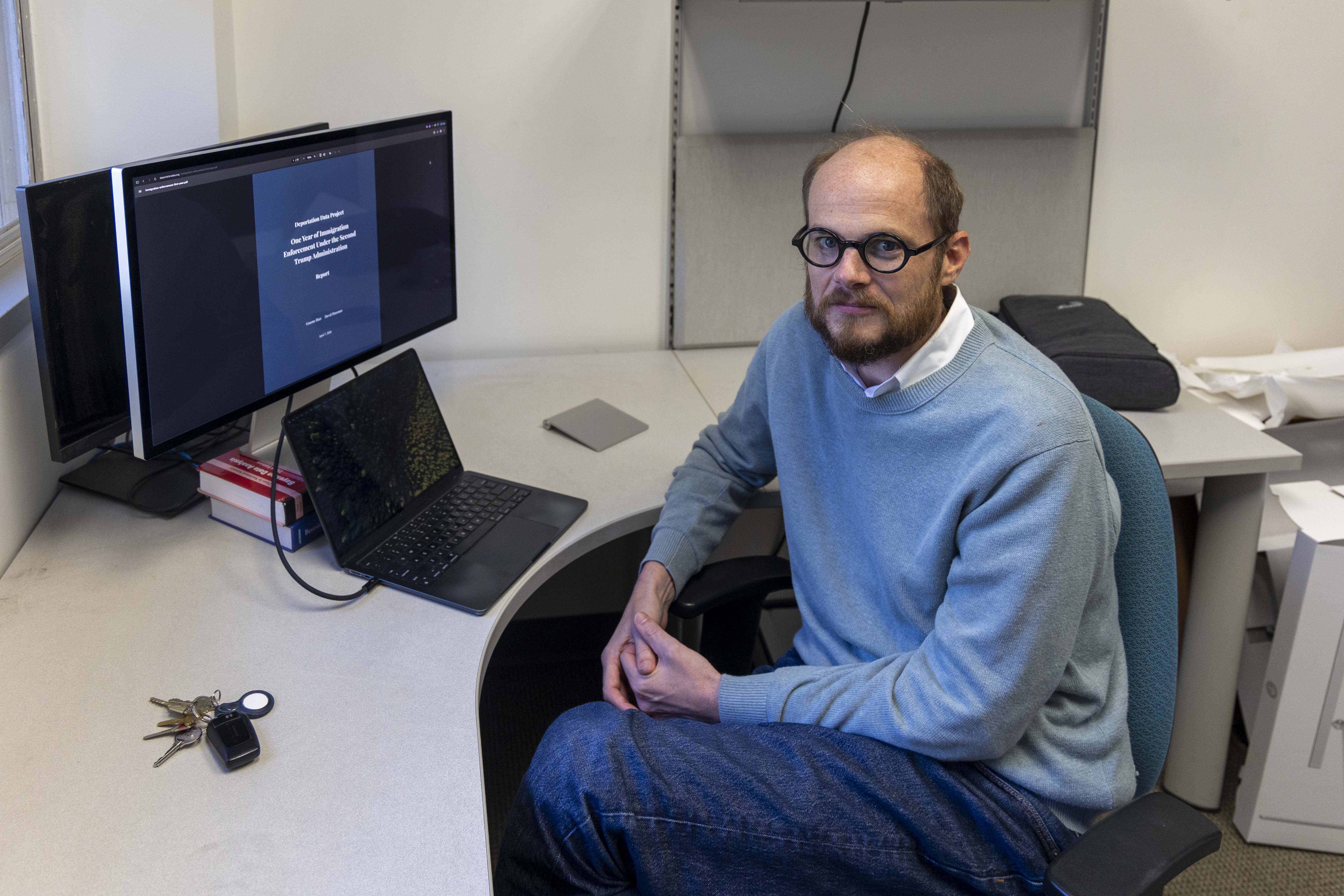
Blair said he hopes scholars, lawmakers and community groups use the data to make informed immigration policy decisions.
The project works with student volunteers from UCLA and UC Berkeley, who fact-check, organize and analyze the data. Law students from UC Berkeley and attorneys across the state have provided litigation support, said Hayley Labia, a research assistant and former Daily Bruin contributor.
Rida Fatima, a second-year political science student and student researcher, said she started volunteering with the project in March to help people better understand the complex data from the federal government. She added that she plans to pursue a career in immigration law.
Some of the data she tracked comes from immigration enforcement near her hometown in Northern California, Fatima said.
“It’s eye opening to see in person how big and how close it (immigration enforcement) is,” she said. “These people, they live amongst us. You never know what can be happening – it’s such a scary environment nowadays.”
The collaboration between UC campuses allows the project to cover more ground, Fatima added.
Jeremy Estrella, a third-year political science student and student researcher, said many local businesses in his hometown of East Los Angeles – a predominantly Latino community – have shut down out of fear of ICE, furthering his interest in the project.
Forty-three percent of Latino-owned businesses in LA county have lost half or more of their business since ICE ramped up its immigration operations in June, according to the Los Angeles Business Journal.
“I became involved because it’s a very pressing issue right now,” Estrella said. “It destroys communities and families.”
Labia, a third-year political science and statistics and data science student, said she was drawn to the project as a second-generation American. The data she cleans is often disorganized and hard to follow, she added.
“Most of what I’ve been doing is gathering a lot of the data, preserving it, cleaning it,” she said. “That’s a monster in and of itself to tackle.”
Blair said he is also looking to retrieve data from the Student and Exchange Visitor Information System – which is used by the federal government and universities to track student visa statuses – to understand if and how the Trump administration revoked students’ visas based on their political beliefs or home country. The Trump administration revoked nearly 2,000 student visas last spring, according to Inside Higher Ed, including those of 19 UCLA students and recent alumni, but reversed the decision in late April 2025, citing the need to develop a framework for status termination.
“UCLA could do a lot more to reassure students and to clarify. … What are the rules that ICE must follow on the UCLA campus?” he said. “There’s a lot more that they could do to reassure all the community about what the risks are and what actions UCLA is taking to protect students.”



Comments are closed.