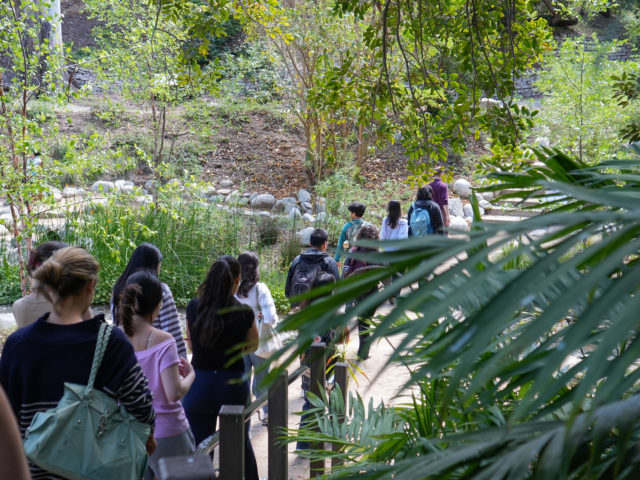
Students in a UCLA Ecological Medicine seminar traded their classroom for the outdoors in spring quarter.
Conor Murray, the instructor for Psychiatry 186, led students through the Mildred E. Mathias Botanical Garden, where they participated in a “forest-bathing” exercise April 13. As students walked through the garden, they paused to smell flowers, lay in the grass and listen to the sound of birds.
The exercise is one of many experiential activities designed to introduce students to the emerging field of ecological medicine, which explores how connecting with nature can improve humans’ health and relationship with the environment, according to the course syllabus.
The course was designed by Project ReConnect, a research group dedicated to understanding the health benefits of ecological medicine, according to its website. The class is part of its initiative to establish the new field through education, research and community building, Murray said.
Project ReConnect is an expansion of the UCLA Psychedelic Studies Initiative, said cofounder Landon Pollack.
Research on psychedelic therapies found that patients benefit from a deeper connection with natural psychedelics, said Dr. Michael Makhinson, a founding academic council member on the project. Psychedelic therapies have historically been used by indigenous communities to connect with other species and the environment, Makhinson added.
Ecological medicine includes a range of practices beyond psychedelics that promote contact with the natural world – such as forest-bathing, community gardening and animal therapy, said Dr. Helena Hansen, a co-founder of Project ReConnect.
“How could some of these practices infiltrate traditional biomedical settings, and how could we bring it into clinical training so that it’s part of the toolkit, so that we could have not only prescriptions for these kinds of activities for patients, but also redesign our institutions, our clinics, our hospitals in ways that really lend themselves to relationships with other species in nature?” said Hansen, who is also the interim director of the Semel Institute for Neuroscience and Human Behavior.
Ecological medicine distinguishes itself from similar fields through its focus on indigenous philosophies of reciprocity and stewardship between humans and nature, said Pollack.
“This is something that has really rung true for people in an era of climate anxiety,” Hansen said. “The wildfires of last year really brought it to the forefront.”
Seminar students explored the health benefits of nature exposure – as well as botanical and psychedelic medicines – through experiential activities and original research projects, according to the syllabus.
Jacqueline Fernandez, a fourth-year human biology and society student, said she first learned about psychedelics and plant medicine through classes for her minor in brain and behavioral health.
“I was really interested in this new form of science,” Fernandez said. “Normally it (topics on plant medicines) would be brushed over in other classes.”
Lyndsey Bui, a fourth-year molecular, cell and developmental biology student said the class allowed her and Fernandez to conduct research on how studying in library spaces that integrate nature can reduce stress and anxiety for students.
Makhinson said he would like ecological medicine to be broadly adopted in medical education and the healthcare system overall.
Michelle Anyanwu, a third-year psychology student, said she was excited to see a course focused on ecological medicine at UCLA.
“We’re moving into a new sphere – a new model that actually reconnects us to how we are able to survive (on this planet) and what that means to our health overall,” said Anyanwu.



Comments are closed.