This post was updated May 17 at 8:05 p.m.
Leanne Betasamosake Simpson paints a clear map toward decolonization with her latest book.
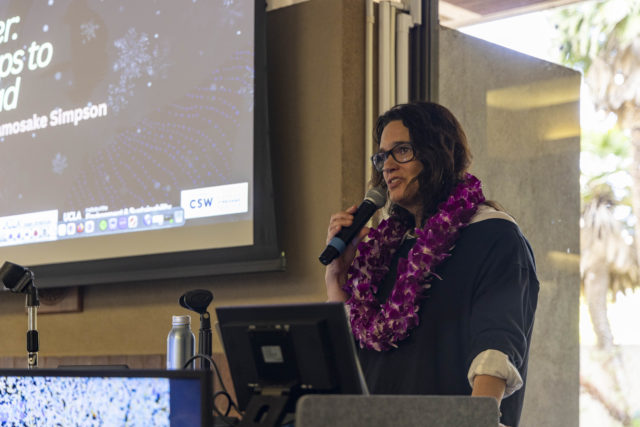
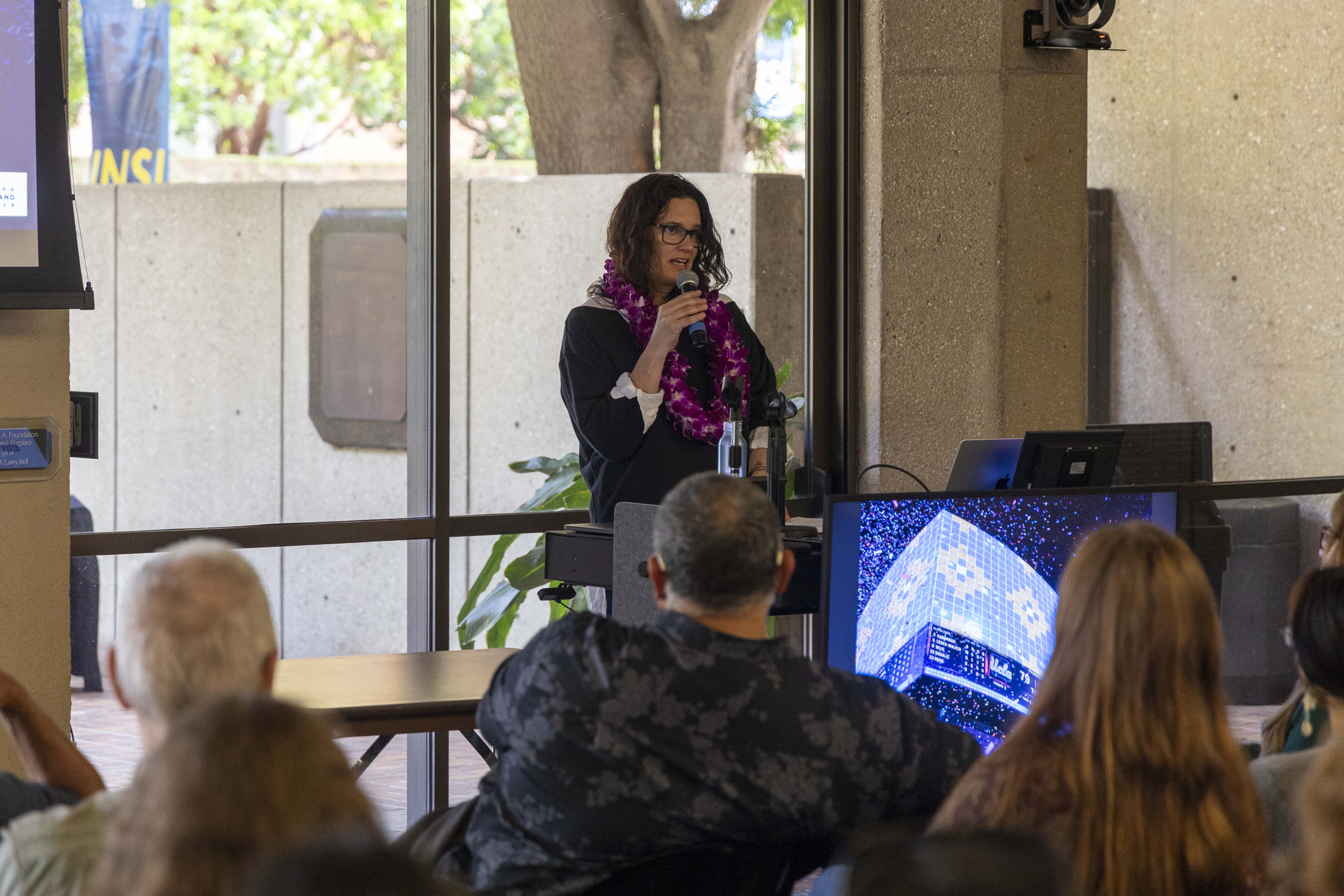
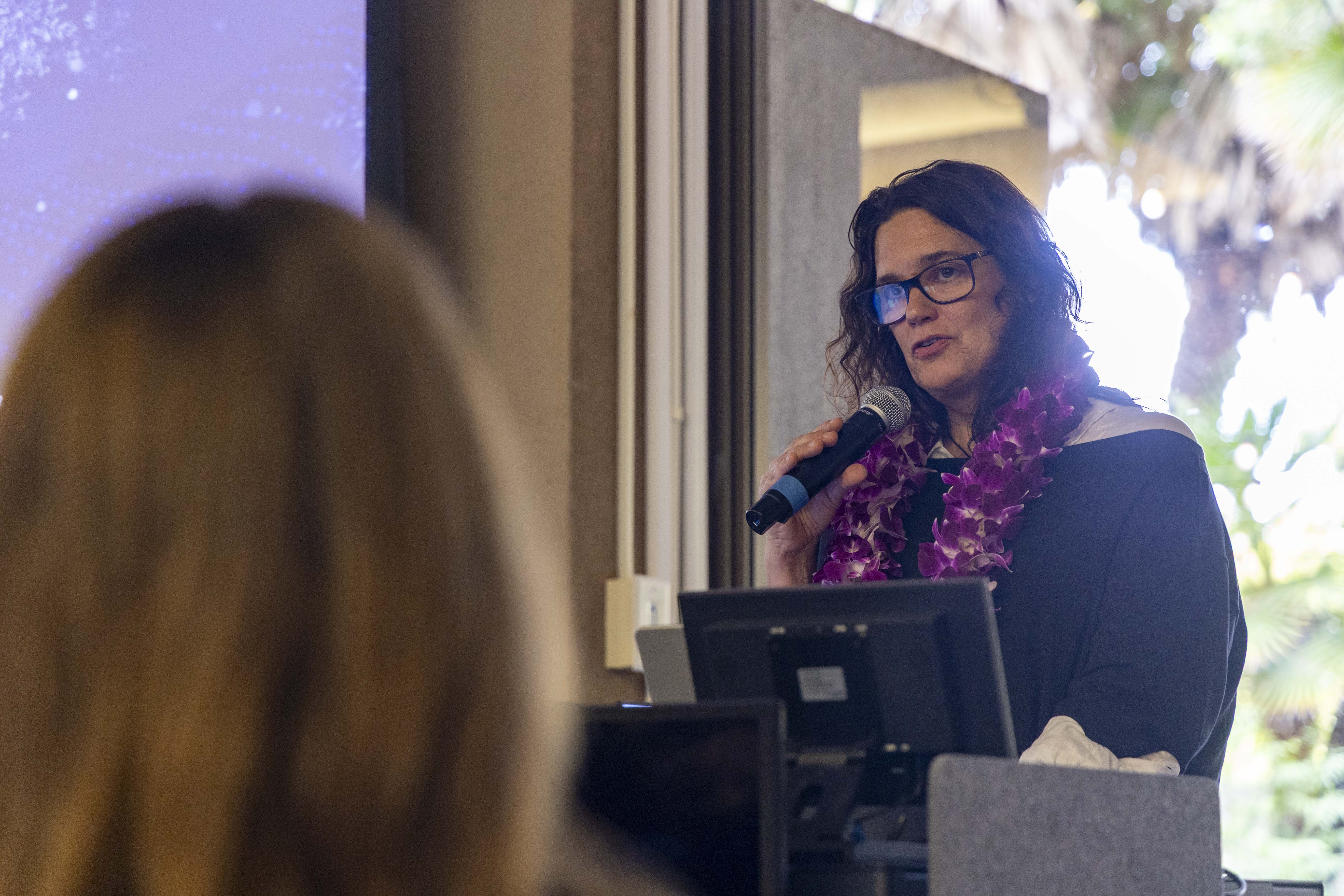
As part of a special speaker series, the UCLA American Indian Studies Center welcomed Simpson on Tuesday for a book talk and signing. Simpson is an Indigenous Michi Saagiig Nishnaabeg author, musician and scholar who recently released the book, “Theory of Water: Nishnaabe Maps to the Times Ahead.” Simpson’s book delves into themes of kinship, reciprocity and the betterment of humanity through nature. She said the book details her theory of interpreting traditional Nishnaabe concepts into contemporary conditions, using them as guidelines for decolonization. One such concept was that of “nibi,” which means “water” in the Ojibwe language.
“Nibi’s theory, or the theory of water, is a scathing indictment of every part of the death machine that has led to this present moment,” Simpson said in her talk. “Nibi rains down on capitalist scaffoldings, revealing captured beings who are separated from the network of life, their value in terms of capital, extracted their bodies withering into disposability.”
After an introduction by members of UCLA’s American Indian Studies department, Simpson took the stage. She started her speech by invoking natural imagery and UCLA’s proximity to the Pacific Ocean and all the species that reside there. Simpson continued by explaining how water connects the land of Los Angeles to the Great Lakes region, where her ancestors resided through shared relationships to waterways.
“Together, my ancestors were skilled at weaving others into the web because they knew we belonged to the family of lakes,” Simpson said. “And when everyone knew they belonged to the family of lakes and were working and knitting themselves into each other, life could be quite stunning.”
[Related: Kiran Desai expands on new book’s theme of loneliness at Hammer Museum talk]
Simpson then told the Nishnaabe story of creation. She said the story follows Gizhe-manidoo, an empathetic spirit and creator of life, creating the world before it started dying off. Failing to sustain life successfully on the first attempt, it was not until asking help from Gizhiigokwe, or Sky Woman, that life was able to persevere, she added. Simpson said Gizhiigokwe recognized the importance of the cycle and remained in the sky as the moon to watch over the Earth and maintain its cycles.
“We were given the responsibility of Mino-Bimaadiziwin, of living in a way that contributes to a continuous rebirth of all living things on the planet,” she said. “We were given the responsibility not to remake the world but to fit into the complex networks of interconnection and interdependence at the ecosystems that make up the planet.”
Simpson then compared the role of humanity to that of water. As a snowflake develops in the sky, Simpson said, it transforms and adapts itself to each condition. Much like how snowflakes find refuge in the ground, she added that we ground ourselves in communities and build coalitions with neighbors.
As the floor opened to questions, attendees asked Simpson to elaborate on some of her ideas. Nohely Guzmán, a doctoral student in geography, probed deeper into Simpson’s framework of decolonization.
“I feel like in many ways, … this was a road map of sorts that you generously drew for us, and I’m really grateful for that,” Guzmán said. “I wanted to ask about care as an analytic but also as a political theory of sorts. And I don’t know if you could share a little bit more about how you landed or how you were sort of conceptualizing that.”
[Related: Katie Kitamura talks new book at Hammer Museum ‘Some Favorite Writers’ event]
Simpson added how in her years studying the topic as a doctoral student, she asked her elders for guidance on treaty and self-determination. As a result, Simpson said they repeatedly took her on geese hunting trips in boats, and it was not until years later that she understood the point they were trying to make. They were not just taking care of her, she said, but taking care of a community. She added that she also found the same lessons in raising a child or caring for someone other than herself.
Simpson said Nishnaabeg grandparents would reuse materials not used in the present moment. From the perspective of the natural world, capitalism is incommensurable with the Indigenous way of life, she said. To rebuild or create a world free of these ideas, Simpson said society must look to the lessons learned by the creation story she told.
In another comment, Fred D’Aguiar, a UCLA English professor, shared his thoughts on Simpson’s emphasis on the role of cyclicality in the creation story.
“The fight is not linear and it’s not history: It’s myth and circular,” D’Aguiar said. “I really appreciated the calm of it. … You unveiled a beautiful circularity. A beautiful mythic time.”





Comments are closed.