This post was updated May 27 at 11:45 p.m.
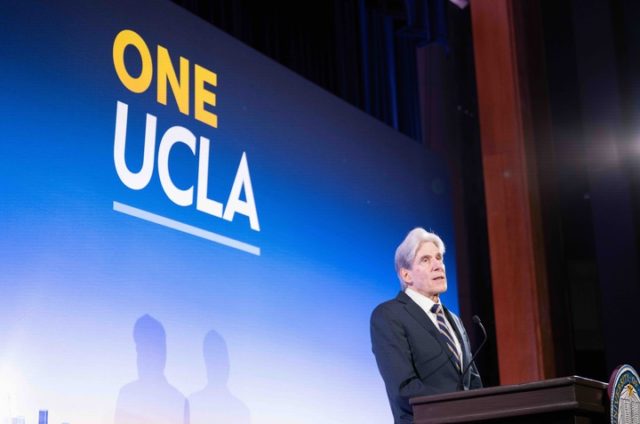
UCLA will use bond funds to reduce UCLA Athletics department’s budget deficit and consolidate its chief financial officer and administrative vice chancellor roles, Chancellor Julio Frenk announced in a Tuesday morning State of the Campus address.
Frenk outlined a three-step plan to address UCLA’s financial shortfalls at the inaugural address, which university administrators, student government leaders, faculty and UC Office of the President representatives attended. Frenk said in the speech that curtailed state and federal funding and rising operational costs impacted UCLA’s finances.
“We cannot allow immediate pressures to narrow our sense of purpose or distract from the long-range work required to sustain UCLA’s mission in this complex environment,” Frenk said in his speech, which was livestreamed on the chancellor’s website. “Our North Star will always be to ensure that the resources entrusted to us by society add maximum value back to society, while always protecting our academic core mission.”
The consolidation of administrative roles comes as Administrative Vice Chancellor Michael Beck announced that he will retire at the end of 2026. Frenk said the university hopes to increase efficiency with the combination of offices.
[Related: Administrative Vice Chancellor Michael Beck to retire at the end of 2026]
The CFO oversees the university’s budget, allocates resources, manages the university’s debt and assets and is responsible for designing campus capital projects, according to the CFO’s website. The administrative vice chancellor office – which has an annual operating budget of nearly $900 million – employs about 5,000 employees and oversees campus operations including digital and technology solutions, facilities management and housing and hospitality.
“In addition to the savings it will generate, this consolidation strengthens our ability to connect strategy with operations and ensure that decisions move forward with focus and discipline,” Frenk said in the speech.
UCLA is projected to generate a $220 million budget deficit for the 2025-26 academic year, UCLA’s Interim CFO Reem Hanna-Harwell said in a March 26 campuswide email. Hanna-Harwell’s figure came more than a month after former CFO Stephen Agostini alleged to the Daily Bruin that financial mismanagement from administrators led to a projected $425 million deficit for the same year.
Frenk announced that Agostini would no longer be UCLA’s CFO four days after the story was published. Hanna-Harwell said in the email that previous deficit estimations reported in the media were inaccurate because they accounted for unapproved spending requests.
[Related: UCLA CFO out days after alleging history of financial mismanagement]
Frenk said he plans to use bond funds to fund most of UCLA Athletics’ accumulated deficit. Agostini alleged the deficit was at least $80 million for the 2025-26 fiscal year and projected to reach about $100 million for the 2026-27 fiscal year.
UCLA Media Relations did not immediately respond in time to a request for comment on the athletics department’s existing budget deficit.
Sports apparel company Under Armour paid UCLA nearly $70 million in settlement money – $50 million of which was invested in the Regents’ fund – in May 2022 after the company tried to terminate its 15-year, $280 million contract with UCLA.
Agostini alleged in February that UCLA Athletics incurred a budget deficit because the only two sports that generate profit are the football and men’s basketball teams. He also alleged that UCLA’s decisions to both hire and fire coaches have contributed to the deficit, as well as the university’s ability to share its revenue with student athletes through NIL.
Frenk said the move to pay down the accumulated deficit will contribute to financial stability for UCLA Athletics.
“The motivation driving our search for bold and innovative solutions will be to ensure that, far from being a drag on our academic mission, Athletics continues its crucial contribution towards expanding access to higher education, enriching student experience, building community within and beyond our campus and offering a platform to showcase values we hold dear, such as fair competition, teamwork and service-oriented leadership,” Frenk said in his speech.
Frenk also said the university is reviewing its real estate holdings, including by evaluating the financial performance and longevity of university-owned properties and seeking out opportunities to diversify its holdings.
“Our objective is not to operate as a real estate enterprise but rather to steward university assets to maximize our mission’s impact, strengthen our financial sustainability and enable us to focus our resources on UCLA’s highest aspirations,” he said in the speech.
Frenk also praised the Initiative to Combat Antisemitism, which he launched in March 2025. The group released a report May 14 urging UCLA to enforce anti-discrimination policies, implement a new definition of antisemitism and ask faculty not to participate in anti-Israel boycotts.
“Combating antisemitism and all other forms of hatred is a moral imperative, one rooted for me in personal history that makes indifference unthinkable,” Frenk said in his speech.
[Related: Initiative urges UCLA to redefine antisemitism, anti-discrimination policies]
The Department of Justice also announced Tuesday that it sued the UC, alleging that UCLA had allowed pro-Palestine protesters to create a hostile antisemitic environment for Jewish students following Palestinian political party and militant group Hamas’ Oct. 7, 2023, attacks on Israel, which killed 1,200 people. Israel’s subsequent military offensive has killed more than 70,000 Palestinians, according to the Gaza Health Ministry.
Frenk denounced the DOJ’s allegations in a Tuesday statement.
“Let me be direct: the suggestion that UCLA has been passive in the face of antisemitism is simply wrong,” Frenk said in the statement.
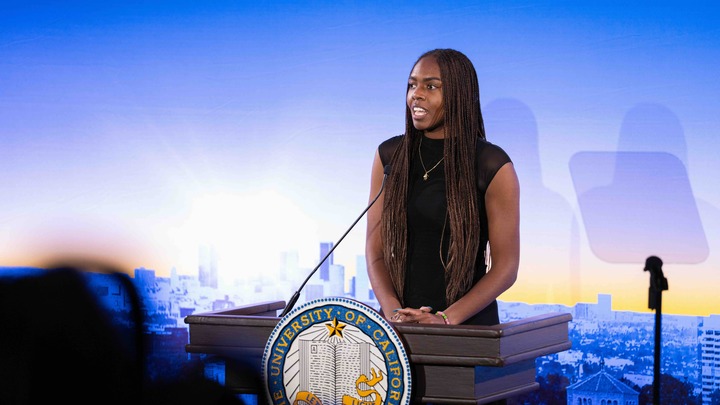
Graduate Students Association President Naomi Hammonds, Chair of the Academic Senate Megan McEvoy and Staff Assembly President Michael McCormack-Colón also gave speeches about the state of the university at the event. Adriana Galván, dean of undergraduate education, was the event’s emcee and introduced each speaker.
Hammonds said that UCLA is strongest when all students feel as though they belong – especially those from marginalized communities, including undocumented students – and recognized students’ lobbying efforts for higher education in Sacramento and Washington D.C.
“We cannot allow fear to isolate us from one another,” Hammonds said in her speech. “We must continue building spaces where students feel connected across disciplines, identities and lived experiences. We have to make the conscious decision every day to choose community over division, empathy over indifference and hope over fear.”
McEvoy called upon UCLA leadership to continue prioritizing shared governance and transparency amid financial hardships facing the school and thanked Frenk for his attendance at Senate meetings.
“This has been a difficult year for UCLA faculty by any definition, but there were also the times that made me feel buoyed and incredibly thankful that my career is here at UCLA, among the amazing community that we have,” McEvoy said.
Throughout his speech, Frenk honored the accomplishments of UCLA athletes – including national championship wins from men’s water polo, women’s beach volleyball and women’s basketball. He asked women’s basketball coach Cori Close to stand while the audience applauded her win, which was UCLA’s first NCAA championship in the sport.
Frenk also honored UCLA researchers, including Nobel Laureates Fred Ramsdell and Andrea Ghez, citing UCLA’s research as the core of its positive impact in the community through bettering the economy and saving lives.
Frenk promised to give an annual State of Campus speech.
“The unprecedented challenges and opportunities we are facing demand we embrace a spirit of boldness, one rooted in the legacy of devotion and talent of those who have come before us to build this great institution,” Frenk said in his speech. “That spirit calls on each of us to think in new ways, to act with purpose and to move forward with conviction. … Let us continue to build together a university worthy of the public trust we must strive to earn every single day for our students, for our communities and for the generations of Bruins yet to come.”