
This post was updated Oct. 11 at 7:48 p.m.
UCLA prides itself on student wellness.
But for a campus filled with pre-med and health-focused students, it fails to teach one of the most basic life skills: cooking.
If UCLA truly wants to support student wellness, it must teach practical skills.
Requiring cooking classes as part of mandatory general education coursework would give students the practical tools to apply what they learn. These classes could teach basic cooking, nutrition, budgeting and meal planning – all skills that directly impact students’ quality of life.
It starts with recognizing that college should prepare students for life, not just exams.
Home cooking is associated with healthier diets and better habits, according to Harvard Health. Yet without the skills or confidence to cook, many students default to convenience. This reinforces patterns they can carry beyond college.
Cooking is not just about following recipes. It is a fundamental part of maintaining physical and mental well-being. Without it, students struggle to translate what they learn about health in class to their everyday lives.
Some students said they feel this gap in their education.
“I haven’t learned much about nutrition,” said Eryn Yang, a first-year molecular, cell and developmental biology student on the pre-med track. “Maybe a little in elementary school, but it was so long ago.”
Yang said most of her understanding of food comes from habits she learned at home rather than formal education. Yang added that she recognizes how important nutrition is, but thinks many students feel unprepared to apply that knowledge in their daily lives.
Nathan Tram, a first-year biology student, said he has taken a class that focused on physiology, metabolism and how the body processes nutrients. He added, however, that he had never been taught explicitly about nutrition.
While some students are yet to learn essential life skills, others face practical challenges in practicing them.
Busy schedules filled with classes and extracurriculars make it difficult to prioritize cooking. Many students rely on eating out or other quick options, reinforcing habits that prioritize convenience over nutrition.
Kayla de la Haye, a professor at the Fielding School of Public Health, said some critical barriers to nutrition are a lack of time and equipment.
She added that she believes UCLA should offer cooking classes that teach time management.
“It’s not just having the skills to buy meals and prep them,” de la Haye said. “You also need to have time to plan ahead to do that and then prep the food.”
Some may argue requiring a cooking class would add another burden to students who already have busy schedules and limited kitchen access. For students living in dorms – or for those who balance work and extracurriculars on top of academics – a mandatory course could feel unmanageable.
A busy schedule is exactly why UCLA should teach cooking classes. A well-designed course would focus on meals students can realistically make with limited time, money and equipment.
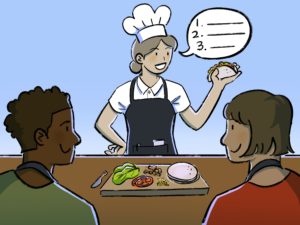
Professors could keep it practical through simple cooking demonstrations, budgeting activities and meal-planning assignments based on actual student schedules. Instead of demanding complicated recipes, the class would teach students how to make affordable meals, understand nutrition and plan.
When UCLA promotes student wellness, it should ask a simple question: Are students actually equipped to take care of themselves?
Because knowing how to cook is not optional; it’s essential.




Comments are closed.