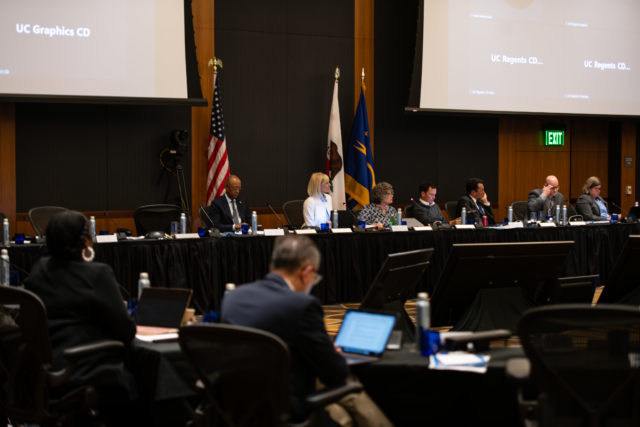
Faculty, students and parents urged the UC Board of Regents to reverse the closure of UCLA’s childcare centers during the regents’ meetings Monday to Wednesday.
The Early Care and Education program, which includes the Krieger and University Village centers, will close in June 2027 because of budget constraints, Executive Vice Chancellor and Provost Darnell Hunt announced in an August email to parents. ECE largely provides childcare services for UCLA faculty and staff’s children.
[Related: UCLA childcare program, which faced 2024 sex abuse case, to close amid budget deficit]
Community members against ECE’s closure wore matching royal blue shirts that read, “Save UCLA Childcare” during the Wednesday public comment session, which took place at the Meyer and Renee Luskin Conference Center.
Sandy Mac, the lead teacher at the University Village Center, said with the support of UCLA, ECE has made significant impacts in early education and pediatric care. The regents must take the value of ECE into account as their meetings continue, she added.
“UCLA’s choice to close our program diminishes our contribution to our UCLA community and our leadership in the field of early education,” Mac said. “I beg of you to please help us reverse this decision.”
[Related: Parents protest sudden announcement of UCLA childcare center closures]
The Wednesday public comment session coincided with an 11:00 a.m. rally in East Pauley Plaza, where about 50 demonstrators called on UCLA to reverse the closures.
Demonstrators started chanting, “UCLA, let our children learn and play.” Protesters then marched in a circle and called, “When childcare is under attack, what do we do?” The crowd responded, “Stand up, fight back!”
“If the UCLA mission is no longer aligned with having childcare as an essential basic need, then it also makes me think maybe I don’t belong here either,” said Stephanie Valadez, an ethnomusicology doctoral student and ECE parent who attended the protest.
Russell Sontay, a fourth-year Chicana and Chicano studies student, said ECE denied one of his two children enrollment this year because of the closures, and he received little support or information on why.
“I came to UCLA to create a better future for my family,” Sontay said. “But I should not have to choose between being present for my children and being able to succeed as a student.”
Professors, students and representatives from external organizations also weighed the positives and negatives of reinstating standardized testing requirements for undergraduate admissions at the UC.
The University paused its standardized testing requirements during the COVID-19 pandemic, later becoming fully test-blind. The UC Academic Senate will decide whether or not to recommend bringing back the SAT and ACT by June 2027.
[Related: UC Academic Senate to decide on recommending SAT, ACT reinstatement by June 2027]
More than 3,000 faculty members signed letters calling on the UC to reinstate testing requirements, arguing that students are not prepared for college-level coursework. Hundreds of humanities faculty also signed a separate June letter urging the University to reinstate the verbal reasoning portions of the SAT and ACT.
[Related: Hundreds of UC faculty call to reinstate SAT, ACT requirements for STEM applicants]
Feliza Ortiz-Licon, the executive vice president for nonprofit organization Campaign for College Opportunity said she believes bringing back the standardized testing requirements could put people with fewer resources at a disadvantage.
“Excellence cannot be captured by a test score,” she said. “We do not live in a multiple-choice world.”
[Related: UC’s consideration of standardized testing return raises preparedness questions]
Ricardo Miranda, who attended the public comment session Tuesday, said he believes the best path to improving knowledge gaps among students is by increasing funding for K-12 schools and early education centers, such as ECE.
Professors were the most frequent proponents of bringing back the SAT and ACT during the three public comment sessions.
Due to a lack of preparedness among students, professors have increased the amount of remedial education to help students catch up – thus lowering the quality of their teaching overall, said David Pan, a UC Irvine European Languages and Studies professor.
Public commenters also raised concerns about other issues across the University, including UCLA Health’s termination of a Medi-Cal contract that allowed low-income patients to use UCLA Health services, an alleged lack of student protections against potential immigration enforcement encounters and the integration of artificial intelligence in UC medical centers.
Outside the conference center Tuesday, dozens of physicians protested the nonrenewal of UCLA Health’s contract with Health Care LA – a non-profit that connects patients who qualify for Medi-Cal to health centers throughout Los Angeles County – on June 30.
They marched while holding signs that read “Keep UCLA Health Public,” and “Patients over Profits.”
[Related: UCLA physicians protest end of contract providing free care for low-income patients]
Michael Owens, the chief medical officer of Health Care LA, said he was worried about those affected by the contract cancellation.
“They (UCLA Health) should take care of the Medi-Cal population,” he said. “Do not think that people who have Medi-Cal should not receive adequate services for tertiary and quaternary care simply because they are poor.”
Contributing reports by Nicholas Mouchawar, campus politics editor

Comments are closed.