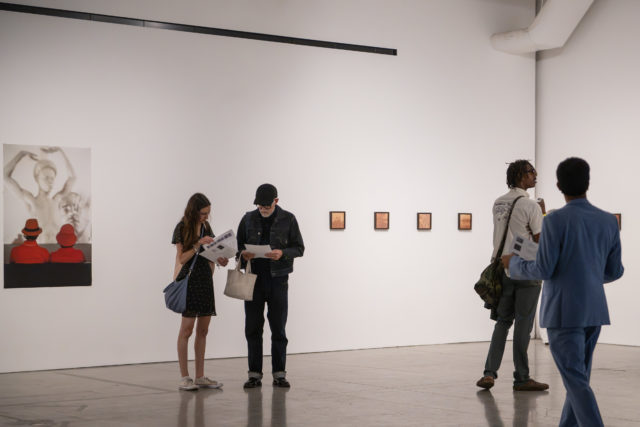
From borders and surveillance to institutions and identities, a UCLA exhibition considers the boundaries that shape how people move about the world.
The 2026 New Wight Biennial Exhibition: “Fugitive Planning” brings together 17 international artists who use fragments, discarded materials and personal histories to imagine what might exist outside of them. The exhibition opened Sept. 23 in UCLA’s New Wight Gallery and was curated by UCLA Master of Fine Arts candidates Sabaah Folayan, Tunmi Da Silva and Luke Francis Austin.
Inside the gallery, viewers were greeted with a circular mirror affixed to a tire, its reflective surface spanning the object’s 27-inch diameter. Afterward, visitors traversed freely through the exhibition’s many enclaves where one work paired glazed stoneware with dirt and another assembled ordinary objects, including bricks and burlap, into sculpture.
Pieces occupied the gallery at different heights and distances. Some installations required viewers to move around or through them. The arrangement echoed the exhibition’s theme of fugitivity, a concept used to explore ways of moving outside established systems, Da Silva wrote in the exhibition statement.
[Related: Postcode Ukraine: In the shadows of war, a photographer looks for stories of solidarity]
“This idea of fugitivity is about strategies for thinking and being otherwise,” Folayan said. “The fugitive has to remain hidden, has to remain on the run, and so these ideas of refusal and opacity, I think, are really intrinsic to fugitivity.”
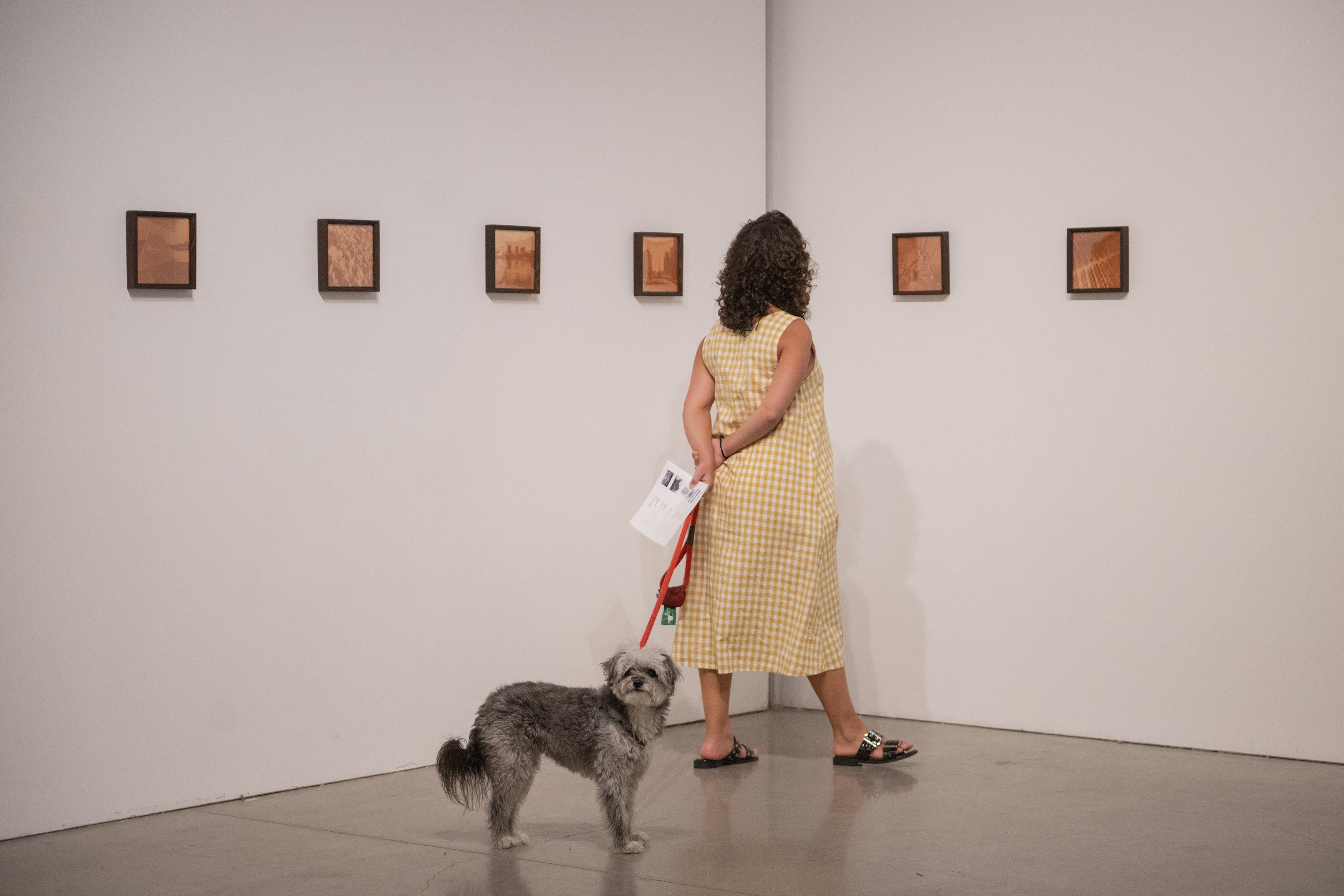
The exhibition addresses themes of globalization, state violence and displacement. “Fugitive Planning” explores the tension between rejecting and recognizing the forces that shape state power and approaches to Black studies, Da Silva wrote in the statement. As viewers strolled through the multimedia expanse, works ranged from sandpaper installations to film.
“It was important to us to demonstrate how Black studies is an all-inclusive epistemology,” Folayan said.
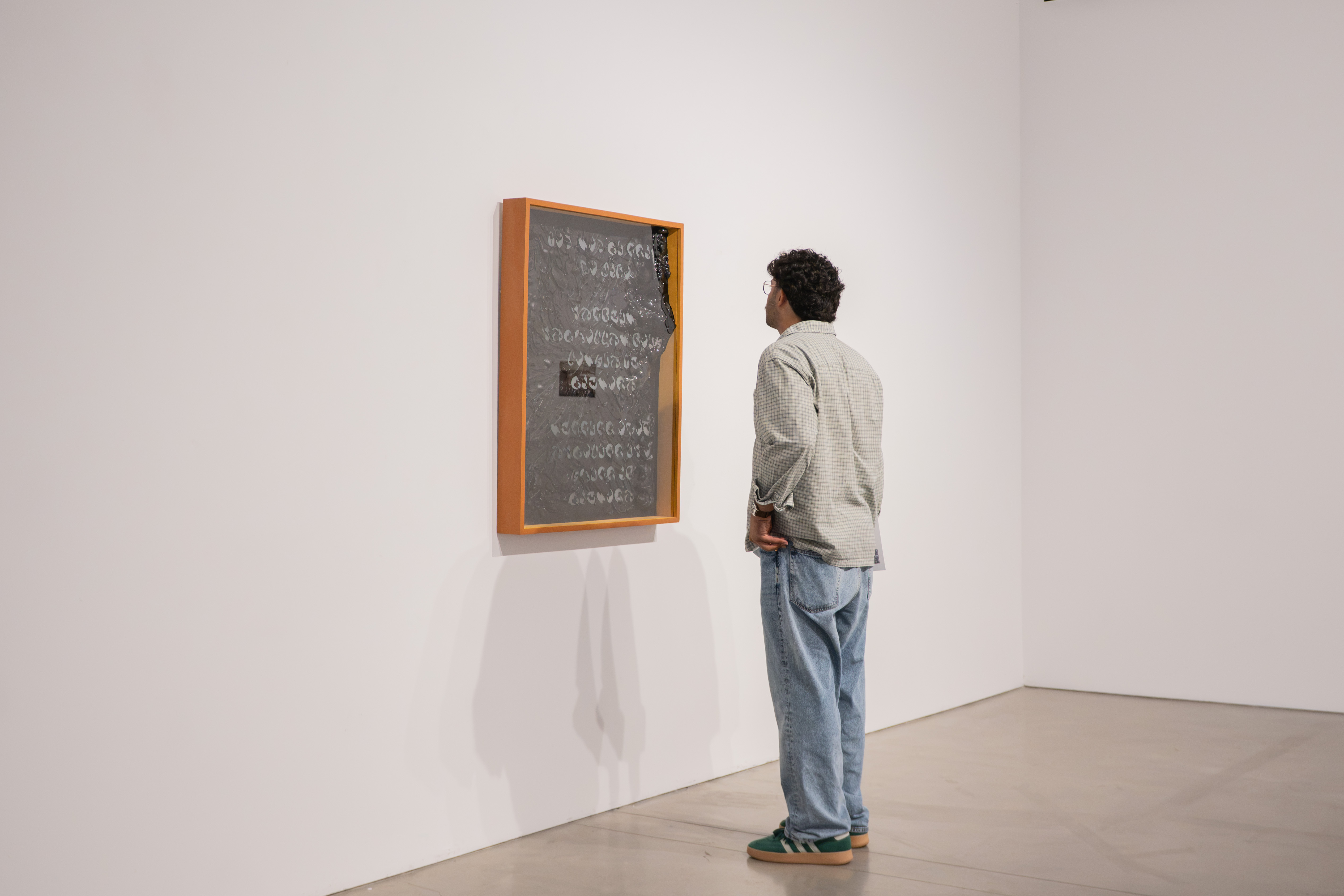
Featured in the exhibition, Natou Fall’s “MaadCode: the great escape” pushed Folayan’s understanding of what could be considered “discarded” in fugitivity, she said. Crafted with seeds from an African tree and broken glass etched with an encoded alphabet the work’s use of discarded materials also pointed to what can be discarded within art history. The piece, they said, demonstrated how discarded materials can point to intellectual traditions that have been pushed to the margins.
The curators drew on the work of Black scholars including Saidiya Hartman and Fred Moten, whose scholarship examines Black life, history and resistance to systems of power. Drawing on Moten’s discussion of existing within institutions such as academia, Austin said the exhibition expanded his understanding of what can function as an institution and how artists can engage with them.
“Practices of freedom in this country have been historically led by Black thinkers,” Folayan said. “It was really awesome to have this opportunity to demonstrate that with this show.”
Eva delaCruz, a second-year art student, described the exhibit as unlike others she’s viewed at UCLA. She said the exhibition’s use of space, color and texture created a distinct tactile experience with references to planning, architecture and urbanism.
“There’s a lot of inspiration to be taken here for our student works,” delaCruz said. “That’s why I’m so glad that it’s here in the art building (Broad Art Center), where I can see it as an art major.”
[Related: Yvette Janine Jackson’s radio opera ‘Harvest’ sows seeds of sound at UCLA Nimoy Theater]
By organizing the exhibition within an art institution while simultaneously questioning how institutions operate, Austin added that they created a meta commentary where the exhibition was the embodiment of the art’s principles.
“Those of us who are marginalized and excluded from systems of power have to find ways of escape,” Folayan said. “Sometimes we work alongside and inside institutions, and we use fugitivity as a way of transmuting resources and energy and remaining true to ourselves.”


Comments are closed.