
Warning: Spoilers ahead.
Despite its exhaustive methods, “You Can See Everything” leaves viewers questioning just how much of what they see is true.
Released Friday, the documentary captures the 34 days before and the three years after fallen tech mogul and convicted felon Elizabeth Holmes was sent to prison. The documentary was co-directed by filmmaker Lance Oppenheim and comedian Nathan Fielder – the latter making his feature-length directorial debut. What begins as an innocuous portrait of the enigmatic Holmes soon morphs into a masterful journey through a fractured two-way mirror of belief and doubt, forcing viewers to confront their own preconceptions of the entrepreneur.
For many followers of Holmes’ trial, it’s hard to believe the inherently invasive project was created at the request of Holmes herself. Holmes hadn’t given a public interview since 2016, the height of her influence as CEO of medical device company Theranos in 2016 until after her November 2022 sentencing. It seems that after she was found guilty of defrauding investors in a highly publicized 2022 trial, she began to think inwards – what mattered most as she faced 11 years in prison?
The documentary acts as an apparent attempt to exonerate her from public scrutiny. Holmes and her husband Billy Evans invited Fielder and Oppenheim to film them and their children at home before she began her prison sentence in May 2023. The couple explain to Fielder and Oppenheim that a display of their domestic life would help the public understand that Holmes’ media representation was a constructed character, rather than a human. Immediately, these scenes leave the audience feeling deceived – it is unnerving to witness an infamous, white-collar criminal read bedtime stories to her children and take family walks along the San Diego shoreline.
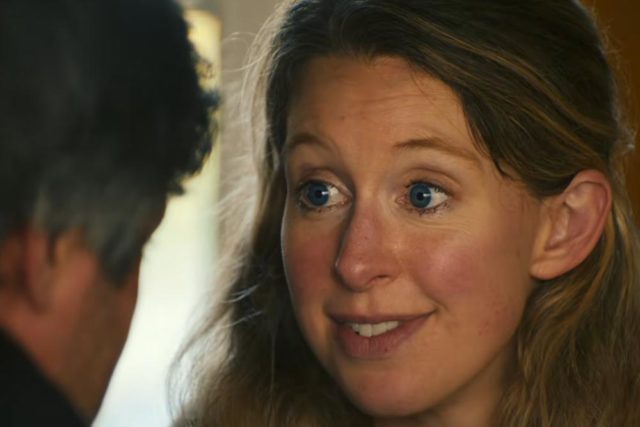
Despite initially intending only to direct and not get in front of the camera, Fielder explained at press events that his mind changed shortly into his stay at Holmes and Evans’ residence – after he discovered that Holmes remains wholly convinced of her innocence. Much of the documentary’s first act is framed in close-ups of the interviewees’ faces during conversations and shot in often-unbearably long takes. This stylistic choice, unusual in documentary filmmaking, functions to cleverly illustrate the film’s core question: In a vacuum, who do you believe?
[Related: Film Review: Gripping ‘Fjord’ navigates the treacherous terrain between faith, family and justice]
The crew’s homestay allows an unfettered Fielder to show off his investigative chops. Fielder, a comedian known for his direct, deadpan style showcased in his comedy programs “Nathan for You” and “The Rehearsal,” proves his delivery isn’t just effective at evoking humor but also at searching for truth. Oftentimes in their on-screen conversations, it seems that Fielder is the only person capable of seeing through Holmes and Evans’ purposefully misleading language and factual inconsistencies – all while eliciting genuine laughter from both the couple and the audience.
But the real magic of “You Can See Everything” comes at the film’s halfway point. Shortly after Holmes reports to prison, Fielder shows actress Amanda Seyfried – who won a Primetime Emmy award for her portrayal of Holmes in the series “The Dropout” – footage of Holmes watching Seyfried’s show. To better understand their interactions with the couple, Fielder and Oppenheim enlist Seyfried to reenact their documentary footage in a move evocative of “The Rehearsal.” In these television-like scenes, Fielder plays himself, opposite Seyfried as Holmes and Christopher Abbott as Evans, even going so far as to shoot in the same house Holmes and Evans stayed at during filming.
This move effectively puts not only the authenticity of Holmes’ narrative, but the conventions of the documentary mode, into question. Through these artificial reenactments of documentary footage, Seyfried, Fielder and his crew seek to understand the validity of the supposedly genuine interactions of the homestay. In the often-hilarious scenes, the directors and audience asked themselves: Were Holmes and Evans being truthful when they insisted on her innocence, or was this entire project a PR move in preparation for “Theranos 2.0”?
In an era of self-serious thinkpieces that explore how the media distorts human authenticity, Fielder and Oppenheim produce a genuinely creative work of social reflection. Throughout the film, the audience is led to suspect almost every participant of believing an obvious lie: Seyfried doesn’t think Holmes alone is guilty; Evans trusts that his wife condones – and controls – his nefarious online behavior; and Holmes is convinced she did nothing wrong. Through virtuoso manipulation of documentary and scripted mediums, Fielder and Oppenheim’s literally close-up study of Holmes forces the audience to reflect on the complicity of not only Holmes’ crime, but of our belief in celebrity persona.
Eventually, Fielder reconnects with Evans as he raises his and Holmes’ children several years into her sentence. Without disclosing too much – because “You Can See Everything” is ironically best seen without knowing much beforehand – Fielder makes a discovery at their new home in Austin, Texas, that recontextualizes his relationship with the couple.
Revelations aside, perhaps one of the most haunting scenes of the film occurs during the final act. As Evans tucks his children into bed, an AI depiction of Holmes, created through state-of-the-art body scans before her sentence, whispers bedtime messages. It is unnerving to see Holmes’ own children speak to an artificial version of their mother as the bookend of her three-hour argument for authenticity. In the end, it seems that not even Holmes’ own family cares to prioritize authenticity over facade, truth over lie.
While viewers supposedly “Can See Everything,” Oppenheim and Fielder’s superb, contemplative storytelling leaves them questioning it all.




Comments are closed.