All public undergraduate college students in California now automatically pass the first barrier to applying to CalFresh, giving more than 200,000 additional students access to the food assistance program.
All undergraduate students enrolled at least half-time in UC, California State University or California Community College programs will automatically meet some eligibility requirements for CalFresh, a government subsidy providing food assistance for low-income individuals and families, Gov. Gavin Newsom announced Oct. 9. CalFresh benefits provide up to $306 a month for food and groceries.
The number of college students eligible for CalFresh, California’s version of the federal Supplemental Nutrition Assistance Program, could increase by about 37% to a total of about 880,000 students, said Jennifer Hogg, a senior research manager at the California Policy Lab.
“This streamlines eligibility for students,” Hogg said. “We’ll see whether this policy change ends up resulting in a big uptick in students participating, but it certainly has a big impact in the number of students who now can access these benefits.”
The change to CalFresh comes after the federal government reduced and restructured SNAP. Congress passed the One Big Beautiful Bill Act in July 2025, which cut $187 billion in funding for SNAP, limited eligibility criteria, imposed new work requirements and shifted more the financial burden of administering the program onto states.
In November 2025, CalFresh funding was frozen for more than a week amid a federal government shutdown. California was one of dozens of states to sue the federal government for suspending SNAP, resulting in a federal judge ruling that the Trump administration had to use contingency funds to keep SNAP functioning.
[Related: Federal government shutdown threatens CalFresh benefits, students’ food security]
Students are generally not eligible for SNAP benefits without meeting specific exemptions, such as working at least 20 hours each week or participating in federal work study. One such exemption comes from participating in employment and training programs, including supervised job searches or programs that build employable skills or improve work readiness.
Individual states have the authority to determine which programs are considered employment and training programs and provide exemptions. CalFresh categorizes some such programs as Local Programs that Increase Employability.
Ordinarily, a program must go through an approval process to qualify as an LPIE. However, the state government bypassed its own system to qualify all public California undergraduate programs as LPIEs, according to an April letter from the California Department of Social Services to county officials.
The percentage of UC undergraduates enrolled in CalFresh has more than quadrupled in the last 15 years as affordability has decreased, Hogg said.
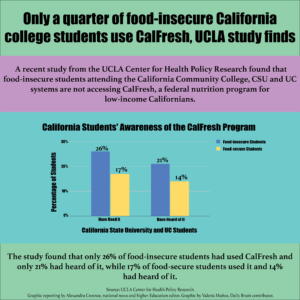
Half of California college students experienced food insecurity according to a January 2025 report from the UCLA Center for Health Policy Research. A California Policy Lab report of the same year found that 20.7% of undergraduate UC students used CalFresh in the 2022-23 school year.
While the change will allow more students to join CalFresh, many people – including most graduate students – will not have increased access to the benefits because the change only applies to undergraduate programs, said Summer Sun, an assistant professor of social welfare at the Luskin School of Public Affairs.
The maximum allowable household income to qualify for the CalFresh is 200% of the Federal Poverty Level, or $2,660 a month for a household of one, according to the California Department of Social Services. A person’s household is determined by physical location, so students who do not live with their parents will not have parental income included in their household income when their CalFresh eligibility is determined.
Students with campus meal plans providing 11 or more meals a week are also ineligible for the program. Community college students have lower eligibility rates because they are more likely to live at home than UC undergraduate students, according to a 2024 California Policy Lab report.
“It’s not a universal program, so you still need to meet certain thresholds.” Sun said. “I would love to see universal eligible policies that provide food as a right, not a privilege.”
Susan Babey, the director of research at the UCLA Center for Health Policy Research, said people who experience food insecurity often do not have access to other basic needs, such as healthcare and housing.
“Not having reliable access to food affects more than just your hunger,” Babey said. “It can affect your physical health, it can affect your mental health, it can increase stress and it also can impact students’ academic performance.”
Strong campus-based CalFresh programs include engagement with faculty to spread awareness about the benefit at the beginning of an academic year, Babey said. Campus basic needs centers can connect students with a variety of resources, such as housing or healthcare assistance, she added.
“There are existing programs within the basic needs center, but also in the community, that can help,” Babey said. “But it can take a lot of time and effort to figure out where they are and get connected to them all.”
Partnerships between schools and counties, which administer CalFresh, can encourage more people to enroll in the program, Hogg said.
Newsom also announced a new state-run campaign designed to raise student awareness of CalFresh on Oct. 9. The campaign partners with and receives funding from California companies such as Instacart and Ripple.
Sun said programs such as CalFresh can provide valuable financial flexibility for students to put their money toward their education or savings, instead of worrying about their next meal.
“Food security is very important for the well-being of college students,” Sun said. “This expansion is a step in the right direction, and there is also a lot more to be done to ensure the food security of college students in California.”


Comments are closed.