This post was updated Oct. 19 at 12:09 a.m.
A UCLA-affiliated research institute plans to revolutionize the liver transplant process by using up to a $19.8 million grant to create functional organs from cells.
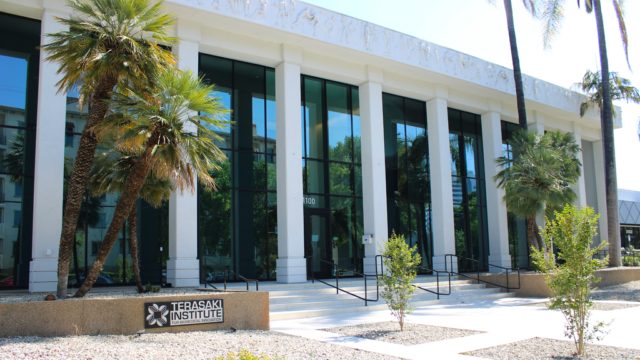
The Terasaki Institute for Biomedical Innovation will work with researchers from UCLA, Cornell University, Pennsylvania State University and other institutions on a project called “Prometheus,” which received the grant from the Advanced Research Projects Agency for Health, a federal research agency.
Prometheus – led by Dr. Xiling Shen, the Institute’s acting director – aims to solve a critical shortage of donor organs, according to an Oct. 2 press release. Among adults added to the U.S. liver transplant waiting list in 2023, 61.9% received a liver within one year, according to the Scientific Registry of Transplant Recipients’ 2024 annual report.
“The end goal is to be able to bioprint a functional liver and what I call the universal functional liver, which will be accepted or not rejected by anyone,” said Dr. Vadim Jucaud, an assistant professor at the Terasaki Institute.

Researchers will use induced pluripotent stem cells – adult cells that have been reprogrammed for a different biological use – to create the synthetic organ, said Dr. Menekse Ermis Sen, a Terasaki fellow.
“We put all the cells together into a small bead, like a boba, but much smaller,” Ermis Sen said. “When we mature them, some of them turn into the other types of cells that a liver needs.”
Dino Di Carlo, chair of UCLA’s bioengineering department, will mass-produce the microscopic gel beads that hold the liver cells together, said Johnson V. John, an assistant professor at the Terasaki Institute.
These clusters of cells form organoids, miniature tissue cultures that can be combined to create a synthetic liver and replicate the same organ functions, Ermis Sen said.
Once the basic structure of the organ is created, blood vessels can self-develop, Jucaud said. However, making the structures strong enough to supply oxygen and nutrients to the organ is a challenge, he added.
“If we don’t have blood that circulates, then the tissue dies,” Jucaud said.
Normally, organ donors and recipients must share certain immune markers on the surface of their cells, or the recipient’s immune system will recognize that the organ is foreign and reject the transplant, Ermis Sen said. However, the cells used to make the synthetic liver are genetically modified to not express any of those markers, Ermis Sen added.
Dr. Jerzy Kupiec-Weglinski, a UCLA professor of surgery, will run studies to test if the synthetic liver is compatible with recipients’ bodies, John said.
Researchers plan to develop the process for growing synthetic livers and test it in small animals over three years, followed by tests in large animals over two more years, Ermis Sen said. The project will then transition to human trials with FDA approval, she added.
If the technology used to create the liver is successful, it can be applied to make other synthetic organs, John said.
“This is a stepping stone for other organ manufacturing, especially in the pancreas, kidney or heart,” John said.
Researchers are working to improve the liver transplant process by taking inspiration from Paul Terasaki, the founder of the Terasaki Institute, who earned his bachelor’s, master’s and doctoral degrees from UCLA. He worked as a professor of surgery in the UCLA School of Medicine for 30 years and developed tests to determine transplant compatibility for organ donors and recipients.
“As his legacy started with organ transplantation, this project is very important for us that we are pushing that frontier forward again,” Ermis Sen said.


Comments are closed.