Editor’s note: This article includes a depiction of violence that may be disturbing to some readers.
UCPD acquired $220,020 worth of drones and less-than-lethal munitions in 2025 and is requesting to buy more, the department said in its Oct. 19 military equipment report.
The drones are part of UCPD’s new Drone as First Responder program. This program aims to “improve situational awareness, reduce response times and provide valuable video evidence during emergency incidents,” said Richard Mejia, the director of emergency communications and information for the Office of Campus and Community Safety, in an emailed statement. Mejia did not respond in time to a request for comment on when the program will launch.
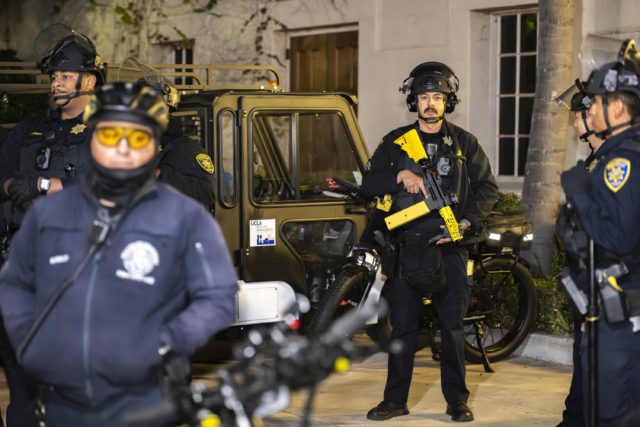
UCPD’s military equipment inventory includes drones and less-than-lethal munitions such as 40 millimeter sponge rounds and projectile launchers as well as long-range acoustic devices, according to the report. The department also owns semiautomatic patrol rifles, but classifies them as “standard issue service weapons” rather than military equipment, per the report.
The report states that UCPD did not use its military equipment outside of training purposes in 2025. The report must be published and submitted to the UC Board of Regents annually under Assembly Bill 481.
Several community members have expressed concerns about UCPD’s equipment inventory, especially the 40 mm launchers, which Mejia said the department owns for officers to have as an option when responding to potentially violent situations.
Michael Chwe, a political science professor, started a petition Friday urging UCPD to stop using 40 mm projectiles, arguing they have been used to suppress peaceful protest and inflict injury upon a student. More than 230 people – including students and staff – have signed the petition as of Sunday.
Chwe will present the petition to UCPD at the department’s forum Wednesday, which is required to be held under AB 481 and allows the public to ask questions and give feedback on the military equipment inventory.
[Related: UCPD keeps 40 mm projectiles, launchers despite LAPD crowd-control ban]
Per AB 481, the UC Board of Regents can grant UCPD permission to use military equipment, but only if it is cost-effective, the department has policies to protect civil liberties and there is “no reasonable alternative” for upholding safety.
The regents must reapprove UCPD’s military equipment and equipment policy at a public meeting at least annually. The regents will review the systemwide policy at their November meeting, UC Office of the President spokesperson Stett Holbrook said in an emailed statement.
UCPD is required to publicize the policy and annual report online as long as the equipment is available for use.
UCPD purchased 120 40 mm munitions for $3,477 in 2025 and owns 3,117 less-than-lethal munitions in total, per the 2026 report. The department is requesting 1,950 additional PepperBall rounds and 50 more 40 mm projectiles.
“All additional equipment is necessary to support the department’s growth and expansion due to UCLA’s acquisition/construction of additional University-owned housing, medical, and administrative properties, as well as in preparation for the 2028 Olympic and Paralympic Games,” the report states.
A January federal court ruling barred the Los Angeles Police Department from using 40 mm projectiles for crowd control after a judge found that officers fired them without warning and at sensitive areas of the body.
In February, Chwe emailed Steve Lurie, the associate vice chancellor for campus and community safety, asking whether UCPD would still use 40 mm weapons after the LAPD ban.
In a response that copied the Daily Bruin, Lurie said UCPD will continue to have the weapons available to combat violent persons and that officers have never and will never use them for crowd control.
Chwe said that UCPD continuing to stock 40 mm weapons indicates UCPD has a lower standard of safety than LAPD.
Jakob Johnson, a UCLA alumnus, said a UCPD officer shot him in the chest with a 40 mm projectile June 10, 2024, while he was attempting to leave a protest he attended as an undergraduate student. Johnson said he was hospitalized and sustained bruising to his heart and lungs.
“So much of myself was shattered in that moment,” Johnson said. “It took so much out of me.”
As a consequence of the incident, Johnson said he withdrew from UC Berkeley School of Law, which he planned to attend after graduating in 2024. He said he felt too preoccupied and didn’t want to attend another school with a branch of UCPD.
“This experience confirmed to me that police officers are prone to the wanton use of force, deploying whatever weapons are in their hands,” Johnson said.
UCPD did not immediately respond in time to a request for comment on the incident.
“I don’t care whether they’re less-lethal or not – I don’t believe that we should equip police to create situations like they created on June 10.”
According to the 2026 report, UCPD acquired three Skydio X10 Unmanned Aircraft Systems – AI-powered camera drones and their associated parts – worth $216,543 last year, and wants to buy two more of the same type. The department also seeks to acquire up to four more drones for training purposes.
The report states that five Skydio X10 drones will allow UCPD to respond to more than 95% of priority police, fire and EMS calls and protect the 2028 Olympic and Paralympic Village.
Skydio X10 drones can launch in less than 40 seconds, move at 45 miles per hour, and fly for up to 40 minutes at a time, according to the manufacturer’s website. More than 1,500 American public safety agencies use Skydio drones, including 83 in California.
Recently, attempts to launch Drone as First Responder programs in California cities have faced opposition from residents and privacy advocates, according to CalMatters.
More than 1,000 public safety agencies have received federal waivers allowing them to fly aircrafts beyond where the operator can see them as of February 2026, according to Federal Aviation Administration records obtained by digital rights organization Electronic Frontier Foundation. The records show that “University of California – Police Department, Fire Department, Emergency Operation Centers, and the UC Center of Excellence on UAS Safety” received a waiver in May 2025, set to expire in May 2029.
Mejia did not immediately respond to whether UCLA’s branch of UCPD has applied for or received a Beyond Visual Line of Sight waiver from the FAA.
Other UC campuses are buying drones and starting similar Drone as First Responder programs, Mejia said. UCPD will conduct outreach to educate the UCLA community on the DFR program before it goes live, he added.
Chwe posted photographs of multiple instances of UCPD officers holding less-than-lethal launchers at student-led protests in 2025 on the petition website, and also sent them to Lurie in his February email. Lurie said in his response that “use” of military weapons specifically refers to when they are discharged, not just carried, and the 2026 report states that UCPD used no military equipment in 2025.
While UCPD’s annual forum must be “well-publicized” under state law, no members of the public presented any questions or concerns at UCPD’s 2023 and 2025 forums, according to archives of the department’s website. In a December 2025 emailed statement, UCPD Operations Bureau Captain Jeffrey Chobanian said nobody attended the 2025 meeting.
“The best way to protect our rights of free expression is to use them, and to resist any attempt to suppress them,” Chwe said. “The deployment of these weapons really cannot be understood as any other thing than trying to suppress protests.”



Comments are closed.