This post was updated Nov. 19 at 8:09 p.m.
After a discovery by a UCLA doctoral student, the future of sunscreen is looking crystal clear.
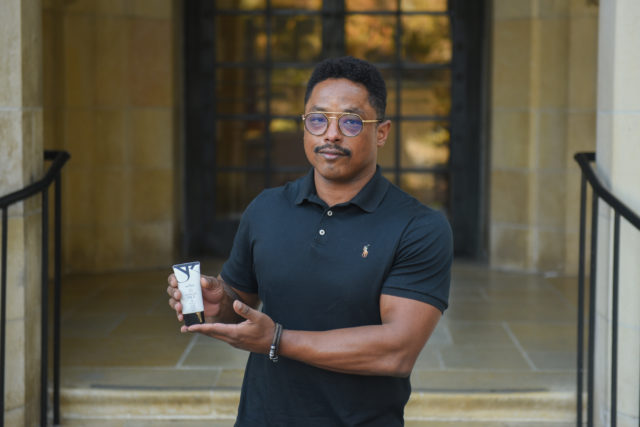
Jason Williams, who is earning his doctorate in chemistry, discovered how to make mineral oxides transparent. That breakthrough could eliminate the white cast commonly left by mineral sunscreen.
His finding has informed his work at My Block Skin, where he serves as the Chief Science Officer.
Launched in 2023, My Block Skin sells clear gel sunscreens, cream sunscreen and SPF lip balm and aims to make sun care inclusive of all skin tones.
“I’ve always loved creating new things and solving problems – difficult problems that there aren’t answers to,” Williams said.
My Block Skin primarily sells clear gel sunscreen, but the company’s new transparent mineral sunscreen technology is patent pending, said founder and CEO Dujon Smith. According to the Cleveland Clinic, sunscreen generally falls into two categories: chemical formulas, such as My Block Skin’s initial production, and mineral formulas. The clinic reports that mineral sunscreens are generally good for sensitive skin and offer immediate protection, but they typically leave a white cast that is especially visible on darker skin tones.
Williams added that there is some public distrust in chemical sunscreen, as some can interfere with hormones and others threaten reef safety. Mineral sunscreen is usually the preferred option – zinc oxide, one of the active ingredients of mineral sunscreen, has broad-spectrum protection without the use of synthetic chemicals.
[Related: Passing by? You might be in this UCLA student’s sketchbook]
Williams said he recognized the potential of his discovery and began looking for an established company that could help bring the technology to market. Making mineral sunscreen more appealing could encourage people to apply enough to receive its intended protection, he added.
“Bringing Jason on really solidified our scientific chops, which I think is going to change the whole trajectory of the business because now we’re science-backed beauty,” Smith said. “We’re bringing something truly new and innovative to the industry now that he’s on the team.”
Williams said his interest in chemistry began when he was a child, after he watched a Discovery Channel segment in which IBM researchers used a microscope to arrange individual atoms on a surface. He added that he became fascinated by the idea of seeing something too small for the naked eye.
However, Williams said he struggled academically, graduating from continuation high school before enlisting in the Marine Corps. After leaving the military, he returned to school and spent 14 years earning his bachelor’s degree, he said.
While studying chemistry at California State University, Dominguez Hills, Williams joined a research lab where his principal investigator helped him envision a future as a scientist.
Working toward his doctoral degree at UCLA, Williams said he learned that his current lab’s principal investigator had been part of the same IBM team behind the microscope he had seen on Discovery Channel as a child.
Aradhna Tripati, a UCLA professor of geochemistry, said Williams’ career path reflects the variety of avenues people can take to become a scientist. She added that Williams’ growth as a researcher has been rewarding to see, especially because he creates opportunities for others who may not see science as a viable pathway.
[Related: Dance student Dakotah Faunteroy embraces creative freedom, self-expression]
In December 2024, Williams founded Elements of Equity, a nonprofit organization that provides paid internships and research opportunities to post-baccalaureate students who did not get into graduate school, he said. He added that through the organization, students have worked on consumer products, which offer an accessible entry point into science because people can draw on their everyday experiences to identify potential improvements.
At My Block Skin, Williams talks to investors, manages the market research team at the Keck Graduate Institute and coordinates student teams that are researching the sunscreen market. The company was recently named a winner at the 2026 UCLA Draper Innovation showcase, which recognizes promising companies, and secured a $100,000 investment.
Williams said he hopes his discovery will help address a longstanding problem with sunscreen use: People may apply less than the recommended amount if they dislike how the product looks on their skin.
“For a sunscreen to work, people have to wear it,” Williams said. “People aren’t going to wear it – or they’re not going to wear enough – if it makes them look bad.”




Comments are closed.